
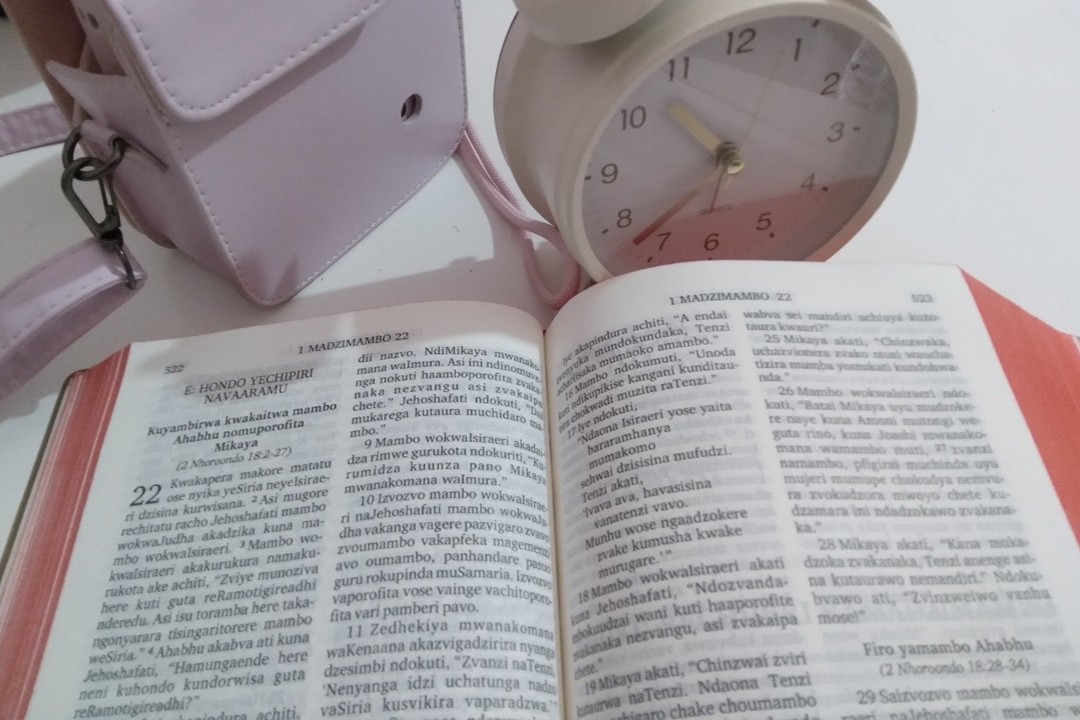
A few weeks ago, one of my young Shona learners in Canada sent me a message with a simple question:
What’s the Shona word for rainbow?
Rather than replying immediately, I asked whether she had tried asking someone at home. ‘I asked my mum,’ she replied, ‘but she doesn’t know.’
And I haven’t forgotten that conversation since. It perfectly captures one of the biggest challenges facing many young Shona families. Even when parents speak Shona fluently, they don’t necessarily know every word. Some words are rarely used in everyday conversation, while others simply fade from memory.
The obvious solution would be to reach for a Shona dictionary. But that’s easier said than done. Comprehensive Shona dictionaries can be difficult to find outside Zimbabwe, and very few are available online.
The Bible in Shona
I gave her a tip she probably wasn’t expecting.
‘Try the Bible.‘
At first, it sounds like an unusual suggestion. But think about it. A rainbow features prominently in one of the Bible’s most famous stories, God’s covenant with Noah after the flood. If there’s one place you’re likely to find the Shona word for rainbow, it’s the Bible.
That recommendation raises an interesting question.
Why is the Bible such a good place to look up unfamiliar Shona words?
The answer has as much to do with the history of the Shona language as it does with the Bible itself.
What does the Bible have to do with written Shona?
Before the twentieth century, Shona was primarily an oral language. Although people occasionally wrote it down, there was no single, standard way of spelling words. Missionaries working in different parts of the country often wrote according to the dialect they encountered, meaning the same word could appear with different spellings.
As Christian missionaries translated the Bible into Shona, they faced a challenge that was as much linguistic as it was theological. They needed a consistent way of writing the language. Bible translation demanded careful choices of vocabulary, grammar, and spelling. A translation that changed from one book to another would have been confusing for readers.
This work required missionaries to study the language in remarkable detail. They documented vocabulary, analysed grammar, compared dialects, and developed spelling conventions. Their efforts produced some of the earliest substantial bodies of written Shona.
A major milestone came in 1931 when the South African linguist Clement Martyn Doke produced his Report on the Unification of the Shona Dialects. Doke’s recommendations helped establish the standard orthography that is still used in schools, books, newspapers, and dictionaries today. His work, however, built upon decades of linguistic research that had already been carried out by missionaries and other scholars.
Whether you approach the Bible as a religious text or simply as a historical document, its translation played an important role in the development of written Shona.
The Bible is a window into older Shona
One of the Bible’s greatest strengths is its age. Much of the translation work began many decades ago. As a result, the Bible preserves words and expressions that were common at the time but may be heard less frequently today.
Languages are always changing. New words enter the language while older ones gradually disappear. Meanings shift. Expressions fall out of fashion. The Shona Bible gives us a glimpse of the language as it was used by earlier generations.
For learners, this makes it far more than a religious book. It is also a valuable linguistic record. Many words that have become uncommon in everyday speech can still be found within its pages, making it an excellent resource for anyone who wants to build a richer Shona vocabulary.
The Bible has an undoubtedly rich vocabulary
The Bible covers an extraordinary range of human experience.
Within its pages you’ll encounter vocabulary relating to family life, farming, livestock, crops, trees, birds, wild animals, clothing, jewellery, construction, cooking, food, weather, emotions, music, leadership, kingship, travel, trade, conflict, justice, and the human body.
Because it tells hundreds of stories involving people from different walks of life, it naturally contains thousands of different words. Perhaps more importantly, those words appear in context.
A dictionary can tell you that a word means something. The Bible shows you how that word is actually used in a sentence. That context often makes unfamiliar vocabulary much easier to understand and remember.
The Bible is easily accessible
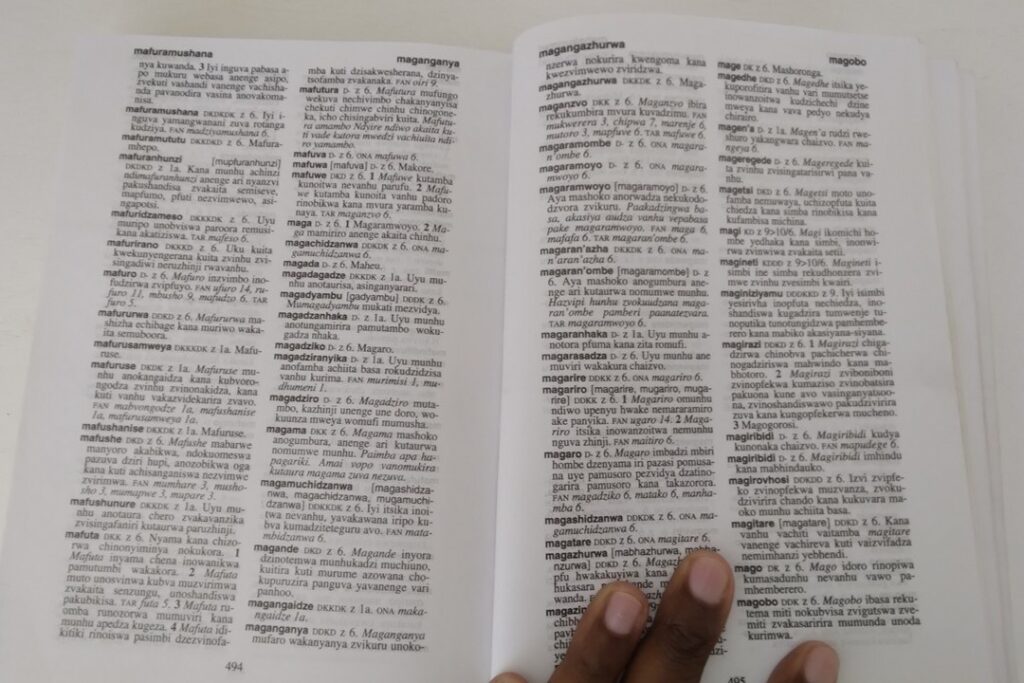
One of the biggest advantages of using the Bible today is that it’s so easy to access. Comprehensive Shona dictionaries remain relatively difficult to obtain, especially if you live outside Zimbabwe. Many are only available in print, and only a handful can be searched online.
The Shona Bible is different. Several versions are freely available online, making them accessible from almost anywhere in the world. Modern search tools make them even more useful.
Suppose you come across an unfamiliar word. You can ask an AI assistant, or simply start with a Google search to find which Bible verses contain the English concept you want translated into Shona.
If the word appears in Scripture, you’ll often be given one or more verse references. You can then open a Shona Bible, read those verses, and see how the word is used naturally in context. Instead of memorising a definition, you’re learning from real examples.
But the Bible isn’t a dictionary
As much as I recommend the Bible, it’s important to understand what it can, and cannot, do.
A dictionary attempts to record the vocabulary of an entire language. The Bible only contains the vocabulary needed to translate the events, places, and ideas found within its pages. That means there are inevitable gaps. You won’t find many words relating to modern technology, such as computer, email, smartphone, or social media. Scientific and technical vocabulary is also largely absent.
There are gaps closer to home as well. Imagine a child wants to learn the Shona names for the rooms in a modern house. They search for words like dining room, passage, garage, or bathroom. Those words are unlikely to appear because houses in the biblical world were organised very differently from the homes we live in today.
Likewise, you won’t find every Zimbabwean plant, bird, insect, or cultural practice reflected in the Bible. It wasn’t written in Zimbabwe, and it wasn’t intended to be a catalogue of Zimbabwean life. For that reason, I wouldn’t recommend replacing a good dictionary with the Bible.
Instead, think of them as complementary resources. The dictionary gives you breadth, while the Bible gives you context.
Why I still recommend it
So, did my learner find the word for rainbow?
She did. The word is murarabungu.
More importantly, she discovered something much more valuable than a single vocabulary item. She discovered a resource she can keep returning to whenever she encounters an unfamiliar Shona word.
No single book contains every word in a language. The Bible certainly doesn’t. But if you’re looking for a freely available, carefully translated, historically significant body of written Shona, it’s difficult to think of a better place to begin.
The next time you come across a Shona word you don’t recognise, try searching for it in the Bible. If it appears there, you’ll not only learn its meaning; you’ll also see it being used in context, just as languages are meant to be learned.
And if someone ever asks you for the Shona word for rainbow, you’ll know exactly where to look.
Related stories:
P.S. Whenever you are ready, here are a few ways you can go deeper with ZimbOriginal:
- Join the ZimbOriginal Shona Book Club — Helping children discover stories, share ideas, and grow confidently in language and life.
- Enrol in 1-on-1 Shona for Kids — Live, online Shona lessons tailored for school-going children — designed to build confidence, deepen vocabulary, and make learning feel like play.
- Subscribe to my newsletter — I explore the intersection of culture, psychology, and human nature in search of better ways to help the next generation thrive.
So what is the Shona word for rainbow?
Hi Det,
The word is murarabungu.
Thanks for stopping by.